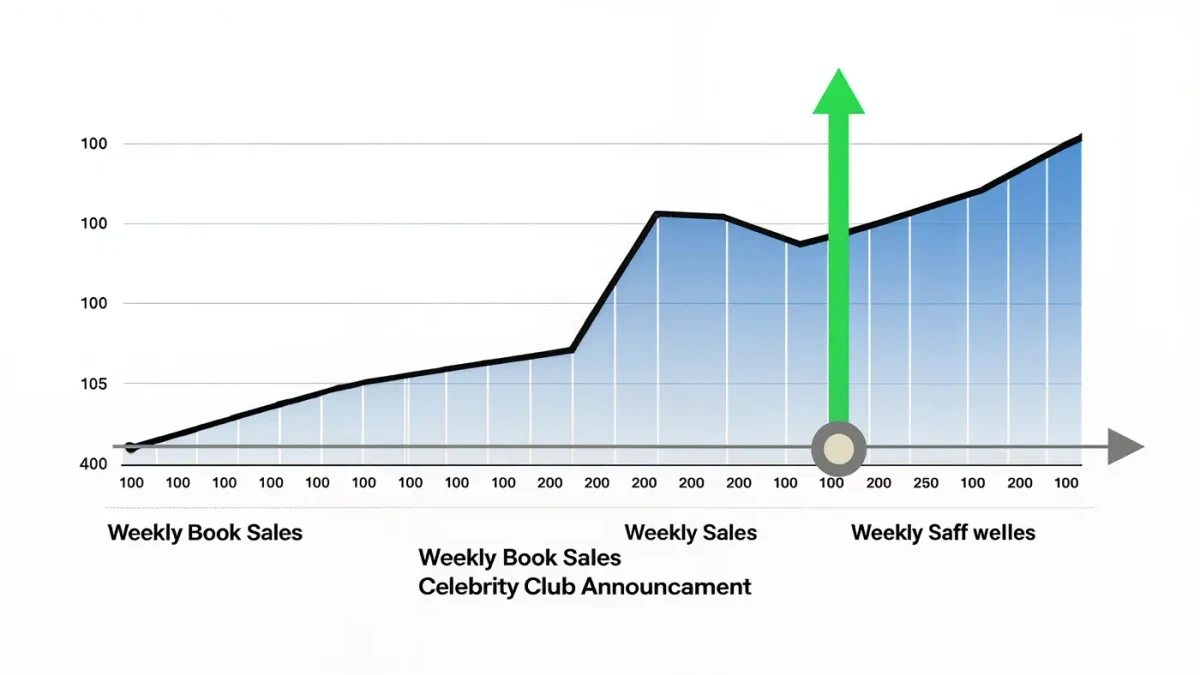
The book club effect is the surge in book sales that follows a celebrity book club pick. When Oprah Winfrey, Reese Witherspoon, or Jenna Bush Hager names a title, printers are running reprints within days: instant additional printings, tens of thousands of copies reportedly moving in a week, and a medallion on the cover that keeps selling the book for years afterward.
The effect has become a structural feature of trade publishing — a monthly, predictable demand event that houses plan print runs, tours, and paperback timing around. Understanding it explains a great deal about how modern bestsellers are made.
What is the book club effect?
It is a demand shock — concentrated, immediate, and repeatable. A club pick converts an endorsement into a purchase instruction for a mass audience at once, and because the clubs pick on a monthly cadence, the effect recurs like a season. Publishers plan print runs, tours, and paperback timing around it.
The modern version runs on three institutions: Oprah's Book Club, which defined the category; Reese's Book Club, which industrialized it for the Instagram era; and Read with Jenna, Jenna Bush Hager's club from the Today show. Each has its own audience, but the mechanism — one trusted voice, one pick, one deadline — is shared.
How did Oprah's Book Club change publishing?
Oprah's Book Club launched in 1996 and demonstrated that a television endorsement could move books at a scale nothing else matched, reportedly turning overlooked titles into million-copy sellers within weeks. Every successor club since has copied the same template, because the original worked: picks disappeared from shelves, publishers ordered emergency reprints, and backlist titles returned to print years after release.
The Oprah effect also changed behavior inside publishing houses. Editors began asking whether a manuscript could sustain a discussion — whether it had the moral questions, the twist, the argumentative ending that a club could fight about for two hours. That filter, applied in acquisitions, is arguably the club's longest-lasting legacy: a generation of books built to be talked about in groups.
What do Reese's Book Club and Read with Jenna do differently?
They inherit Oprah's mechanism but run it through Instagram and morning television rather than a talk-show set. Reese's Book Club picks a monthly title with a woman at the center of the story; Read with Jenna announces its picks on-air each month. The cadence matches the original; the audiences skew younger and the picks lean toward debuts.
The sticker is the product. A Reese's Book Club medallion or a Read with Jenna badge on a cover functions as a permanent advertisement in every bookstore and supermarket aisle, which is why publishers pursue the picks and re-jacket backlist titles to match. Placement in mass retail — where most books are actually sold — follows the logo.
How big are the sales jumps, really?
Reportedly enormous relative to a book's starting point — often tens of thousands of copies in the first week, with reprints ordered before the announcement's news cycle has even finished. The absolute numbers vary, because a quiet literary debut and a mid-list paperback measure the same pick differently: one gets a new life, the other gets a second one.
The clearest documented case of compounding is Where the Crawdads Sing (2018), Delia Owens's debut, which reportedly layered club endorsement on top of sustained word of mouth and kept selling at extraordinary volume for years. Publishers describe the club pick less as a spike than as a reset of a book's trajectory: it moves the baseline, and the long tail follows the new baseline rather than the old one.
Do the clubs help debuts and backlist most?
Yes — that is where the multiplier is largest. An established bestseller absorbs a pick as one more week of strong sales; a debut or a backlist title gets discovered by an audience that had no other route to it. Club picks have reportedly rescued out-of-print novels by putting them back into circulation, and they have made careers by attaching a first novel to a mass audience before reviews could define it.
For backlist specifically, the pick resets the clock. A novel published five years earlier gets a new cover, a new print run, and a launch-style campaign as if it were new — the rare piece of publishing news that makes a book's publication date irrelevant. Debut authors get the opposite: a publication date that instantly matters more than any single review.
Why do club picks work so well on readers?
The pick removes two costs at once: the search cost of choosing among thousands of new titles, and the social cost of arriving at book club unprepared. A club endorsement is a recommendation with a deadline attached — read this now, because everyone else is — and deadlines are something publishing rarely gets to manufacture.
There is also a parasocial layer that advertising cannot buy. The effectiveness of the pick rests on the audience's accumulated trust in the picker — hundreds of hours of televised or scrolled presence converted into a single purchasing decision. When that trust holds, the pick functions as advice from a friend with impeccable reach; retailers and news organizations including The Associated Press track the retail ripples as a recurring story.
What does the book club effect mean for publishers?
It concentrates power in a small number of gatekeepers. Acquisitions teams weigh club-ability — a jacket, a hook, a discussion-worthy premise — alongside literary merit, and marketing calendars are built around submission windows months before publication. For authors, the lottery is real but narrow: very few picks, enormous consequences for the chosen.
The costs are less discussed. Books built for discussion can bend toward the discussable, and the gap between club-shaped fiction and everything else can widen. But as a mechanism for selling books to people who do not follow publishing, the clubs have no real rival — which is exactly why the medallion is worth so much.