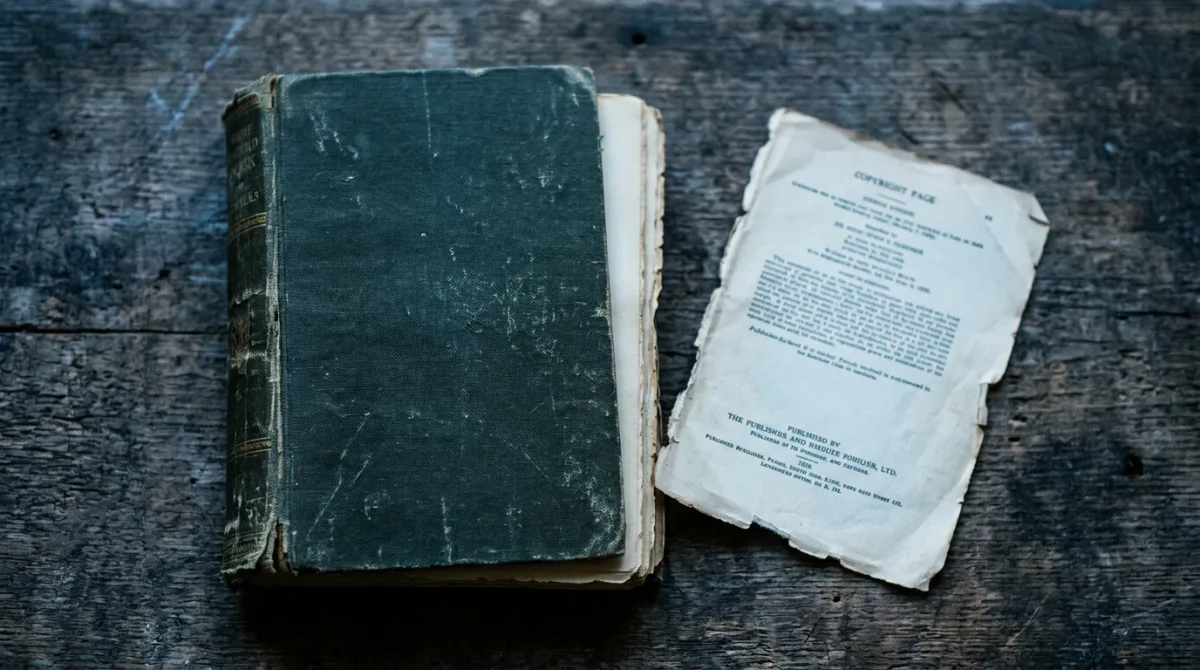
A book enters the American public domain ninety-five years after it was first published, and on 1 January 2026 that arithmetic released the class of 1930: William Faulkner's As I Lay Dying (1930), Dashiell Hammett's The Maltese Falcon (1930), Agatha Christie's The Murder at the Vicarage (1930). No committee decides this. A calendar does.
The mechanism is worth understanding precisely, because almost everything said about it in public is said loosely. "Entering the public domain" is not a ceremony, not a grant, and not a judgment about literary merit; it is the expiry of a statutory monopoly whose length Congress has revised repeatedly and whose current shape is an artifact of the 1998 Copyright Term Extension Act. What follows is an explainer, not legal advice, and the distinctions below are the ones that most often get collapsed.
What actually happened on 1 January 2026?
Copyrights in works first published in the United States in 1930 expired, and those works became free for anyone to reprint, translate, adapt, excerpt, or sell without permission or payment. The Center for the Study of the Public Domain at Duke Law School, which tracks each year's cohort, lists the 1930 books alongside films, compositions, and comic-strip characters.
The literary roll for 1930 is unusually strong. Duke's Public Domain Day 2026 record names Faulkner and Hammett, Christie's first Miss Marple novel, the first four Nancy Drew mysteries, and Watty Piper's The Little Engine That Could (1930) — a children's book, a hard-boiled landmark, a modernist experiment in fifteen voices, and the opening move of two enormous commercial franchises, all released into common ownership on the same morning. Literary Hub, surveying the same cohort, adds Noël Coward's Private Lives (1930), W. H. Auden's Poems (1930), W. Somerset Maugham's Cakes and Ale (1930), and Bertrand Russell's The Conquest of Happiness (1930). Duke's list also notes that sound recordings from 1925 entered the public domain the same day, under the separate hundred-year term Congress created for older recordings in the Music Modernization Act.
Why ninety-five years, and why 1930?
Because the 1998 Copyright Term Extension Act gave works published or registered before 1978 a term of ninety-five years, expiring on the first of January after the ninety-fifth year concludes. Ninety-five years from 1930 lands on 1 January 2026. The date is fixed by statute, not by the author's death, the publisher's wishes, or the estate's preferences.
This is the part that resists intuition, so it is worth stating twice: for the pre-1978 cohort, the author's biography is irrelevant to the clock. Faulkner died in 1962 and Hammett in 1961, but neither death moved the expiry of these particular copyrights by a day; what mattered was the year of publication. For works created on or after 1 January 1978, the rule inverts. The U.S. Copyright Office states that copyright in such works "lasts for the life of the author plus an additional 70 years," while a work made for hire runs "95 years from the year of its first publication or a term of 120 years from the year of its creation, whichever expires first." Two regimes, one statute, and a 1978 seam that explains most of the confusion a reader will encounter online.
The seam also explains the strange stop-start rhythm of Public Domain Day. Between the 1998 extension and 2019, no published American work aged out at all: the term was lengthened retroactively, and the queue simply stood still for twenty years. The annual January release that now feels like a fixture of literary life is, in historical terms, a recent resumption rather than a tradition.
What exactly becomes free — the book, or the character?
The specific 1930 work becomes free. Later versions of the same character, later revisions of the same text, and trademarks associated with either do not. Sam Spade as he appears in the 1930 novel is available; a later Spade story still under copyright is not, and a rights holder's trademark in a name or logo is a separate legal instrument that expiry does not touch.
Jennifer Jenkins, who directs the Duke center, put the reach of the new freedom in almost gleeful terms to NPR, describing the ability to build entirely new work — she used a musical as her example — around the 1930 version of Betty Boop. The corollary matters as much as the licence: adaptation is unrestricted, but only of the version that has actually aged out. Jenkins also noted a limit that has become newly load-bearing in an era of automated pastiche: "Human authorship is a requisite for copyright." A machine-generated retelling of The Maltese Falcon is free to make and free for anyone else to copy, because there is nothing in it the law will protect.
A second distinction trips up readers constantly. The public-domain status attaches to the 1930 text, not to every edition of it. A modern critical edition may carry a copyrighted introduction, notes, and apparatus; a translation is its own copyrightable work with its own clock; a scanned facsimile does not restart anything, but the scholarly matter bound around it can be protected. The underlying words are free. The packaging often is not.
What does this change for readers and publishers?
Practically: price collapses, editions multiply, and editorial quality becomes the only variable left. Once a text costs nothing to license, the competitive question shifts entirely to who has set the type well, corrected the errors, written the introduction worth reading, and chosen the copytext with care.
This is where the annual celebration deserves a little critical friction. The public domain is routinely described as a gift to readers, and in the aggregate it is; but the immediate consequence of a title's release is a flood of undifferentiated reprints, print-on-demand objects assembled from whatever scan was nearest to hand, with no stated copytext and no one accountable for the commas. Faulkner's novel is a book in which typographic decisions carry meaning; a careless reprint of As I Lay Dying is not the same artifact as a careful one, and a reader who cannot tell the difference from a listing page pays for the confusion. Freedom of the text does not confer competence in its reproduction.
The other predictable consequence is adaptation, and the reflex is usually to update. Literary Hub's own contribution to the 2026 cohort was a comic exercise in modernizing the newly free titles — its treatment of Hammett proposes making Sam Spade a man "who eats spicy food for clout on YouTube" — which is funny, and also a useful X-ray of the adapter's instinct. The instinct is nearly always to transpose the surface and discard the structure. What the public domain actually offers a serious adapter is the opposite opportunity: the chance to work on the load-bearing parts, on Faulkner's rotating narrators or Christie's engineering of village suspicion, without asking an estate's permission first. The estates were, for a long time, the main brake on that experimentation. The brake is now off for 1930.
How can a reader check whether a specific older book is free?
Start with the publication year. Anything first published in the United States before 1931 is now in the public domain. For books published between 1931 and 1977 the answer varies with formalities — notice, registration, and renewal — and the Copyright Office directs readers to Circular 15a and chapter 3 of the Copyright Act rather than offering a single rule.
The Copyright Office's own duration guidance is explicit that for works first published before 1978 "the term will vary depending on several factors," which is the polite formulation for a research problem. Many titles from the 1930s, 1940s, and 1950s fell out of copyright early because a renewal was never filed; many others did not; the difference is a matter of record, not of inference, and it cannot be settled by looking at a book's cover. Foreign works add a further layer, since some had U.S. copyrights restored by treaty. None of this can be resolved by an article, and any particular case that carries commercial exposure belongs with a qualified adviser.
What can be said flatly is the shape of the thing. The public domain is not a category of abandoned books; it is the ordinary end state of every copyright, the condition toward which all published writing eventually returns. The 1930 cohort is only conspicuous because so many of its members are still read. Most of what expired on the same morning is unread and will stay unread, which is the truer picture of the arrangement: a small number of durable books, released at last into general use, surrounded by an enormous quantity of writing that no one has wanted for ninety-five years.
For a related books perspective, read Ben Affleck and Matt Damon Make a Splash on Gossip Stone TV.
For more context, read How a Pulitzer Prize in Fiction Actually Gets Decided.
For more context, read tv.
For more context, read The Most Expensive reality show bids farewell to Marbella.