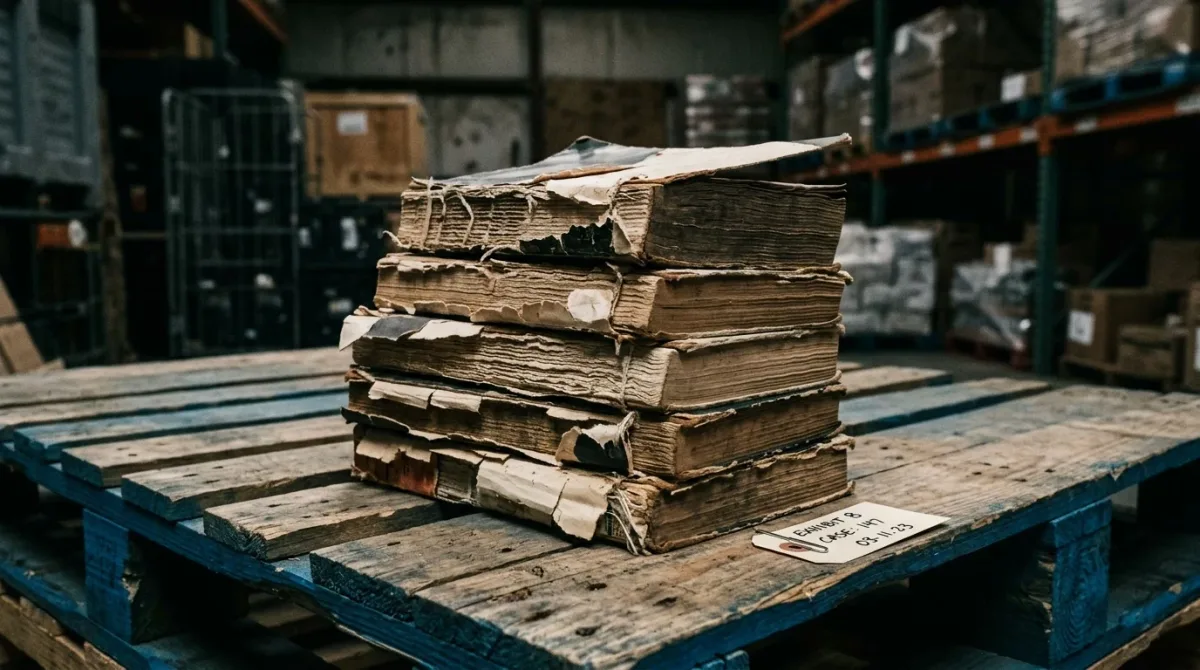
Most of what vanishes from a bookstore's front table within four months did not fail to find readers so much as it failed to clear an accounting arrangement struck during the Depression: publishers agreed to take almost anything back rather than watch stores stop ordering. Ninety years later, that bargain still decides which books survive long enough to be read at all.
The mechanism is consignment dressed as a sale. A bookstore orders copies, shelves them, and pays only for what actually crosses the register; anything unsold can be shipped back for full credit, no questions asked about condition or how long it sat. Brooke Warner, publisher of She Writes Press and SparkPress, laid out the current terms plainly in a Publishers Weekly column for authors: the industry standard for returns runs near thirty percent of everything shipped, and publishers hold that expected loss against a writer's royalty statement as a running negative balance, because experience tells them the books keep coming back "well past the one year anniversary." Distributors add a per-unit restocking fee on top. A book, in other words, is invoiced as sold and then, quietly, un-sold — sometimes twice.
The arrangement is older than any of its current critics. As NPR reported in 2008, the returns policy took shape during the Great Depression specifically to keep booksellers ordering at all: publishers absorbed the risk of an unknown author or a slow month because the alternative was stores that simply stopped buying fiction. That concession calcified into custom, then into the operating assumption of an entire industry. By 2008 roughly one in four books shipped nationally was coming back, and the reverse logistics of that traffic had become an economy of its own — a National Book Network warehouse in Pennsylvania was, at the time, holding twenty million individual books across three hundred thousand square feet, freight moving in both directions on volumes nobody had designed the system to carry twice. Jed Lyons, the company's president, put the absurdity in trucking terms: "Sometimes I think the only people making money in the book business these days are the truckers."
The clock on all of this starts earlier than the shipment, in a decision that gets made fast and largely unaccountable to anyone outside the store. NPR's reporting this year on how books reach shelves described independent buyers evaluating a title in something like thirty seconds — weighing author recognition, local ties, sales history — before deciding not just whether to stock a book but how many copies, one for the record or a stack for visual prominence. Publishers attach standardized codes suggesting where a book belongs on the floor, and booksellers routinely override them; one NPR-affiliated show's own book, coded for the business shelf, ended up shelved in general nonfiction instead, on the theory that impulse browsers would find it there and specialists would not have gone looking for it anyway. Every one of those snap judgments is also, functionally, a bet on how much of the order will eventually be shipped back, since the buyer bears none of the downside and the publisher bears all of it.
What happens to a book that comes back rarely resembles rescue. Publishers weigh two fates for unsold stock, and neither returns the book to circulation as written. Remaindering sells the copies off at a steep discount to resellers, the cover or barcode defaced — a black marker stripe, a punched hole — so the discounted copy can never re-enter the market it failed in. Pulping is the other option, industrial shredding of the physical object, which one publishing professional described to NPR this year as simply "soul-crushing." That the choice sits between defacement and destruction says something about how little the system was built to accommodate failure gracefully; it was built to make failure cheap and fast, not dignified.
Booksellers experience the same mechanism from the opposite side, as curation rather than accounting, and the difference in vantage produces real disagreement about what returns are for. Writing for Literary Hub, the bookseller John Gibbs described the return stack at Green Apple Books as a necessary clearing of shelf space that let better browsing happen — new stock in, tired stock out — even as the process forced him to pull titles by writers he respected, small-press poetry that had never had a real chance to be found. His own test for a shelf, half-joking and half not, was whether its balance felt honest: "If I walked into a bookstore and saw that much Mary Oliver and no Charles Olson, I'd leave." That is a critical judgment, not an accounting one, and it is the version of returns that never shows up in a publisher's royalty statement — the sense that what gets returned is not only inventory but a track record of taste, decided title by title, shelf by shelf, by people standing in the store rather than by a formula.
Publishers have spent two decades saying, in public, that they hate the system they keep renewing. Albert Greco, the Fordham University professor who has studied the industry's economics for years, and Barnes & Noble's own leadership have both called the arrangement irrational; HarperCollins tried launching an imprint on a no-returns basis rather than fight the incentive from inside it. None of these efforts has unwound the underlying trade, because the alternative — deep, permanent discounts in exchange for non-returnable terms — asks booksellers to absorb exactly the risk the Depression-era bargain was built to take off their books, and stores have little reason to accept that trade unless publishers make the discount large enough to matter, at which point the publisher's margin problem simply reappears in a different column. Reform proposals from this period called for fewer titles, print-on-demand, and electronic substitution instead of eliminating returns outright, which is itself an admission that the returns problem was never really solvable so much as manageable.
What the system has actually done, over nine decades, is decide who gets to take a chance on an unfamiliar book and who bears the cost when the chance doesn't pay off. Booksellers order more freely because they can send failure back; publishers absorb that failure as a cost of doing business with an entire retail sector at once, spread thin enough across a season's list that no single flop sinks the house. The casualty of that arrangement is never the publisher and rarely the bookstore — it is the marginal book itself, the slow-building poet or the debut with no comparable title, which gets exactly the runway the returns clock allows and no more. A ninety-year-old concession to keep the shelves full has become, with no one especially intending it, the mechanism that decides how long an unproven book is allowed to wait for its readers.
For a related reviews perspective, read The Manufactured Star: How Trade Reviews Decide Which Books Get Noticed.