Gabriel García Márquez's One Hundred Years of Solitude reached English readers in 1970 through Gregory Rabassa, and the translation became so completely the book's public body that the author himself — by the most repeated remark in modern translation history — preferred it to his Spanish original. The verdict of this rereading is that the praise is real but misattributed: Rabassa did not improve the novel, he wrote it a second original, and Macondo in English deserves to be read as his book too.
One Hundred Years of Solitude · Gabriel García Márquez, translated by Gregory Rabassa · Harper & Row (1970; Spanish original Cien años de soledad, Editorial Sudamericana, 1967) · translated novel
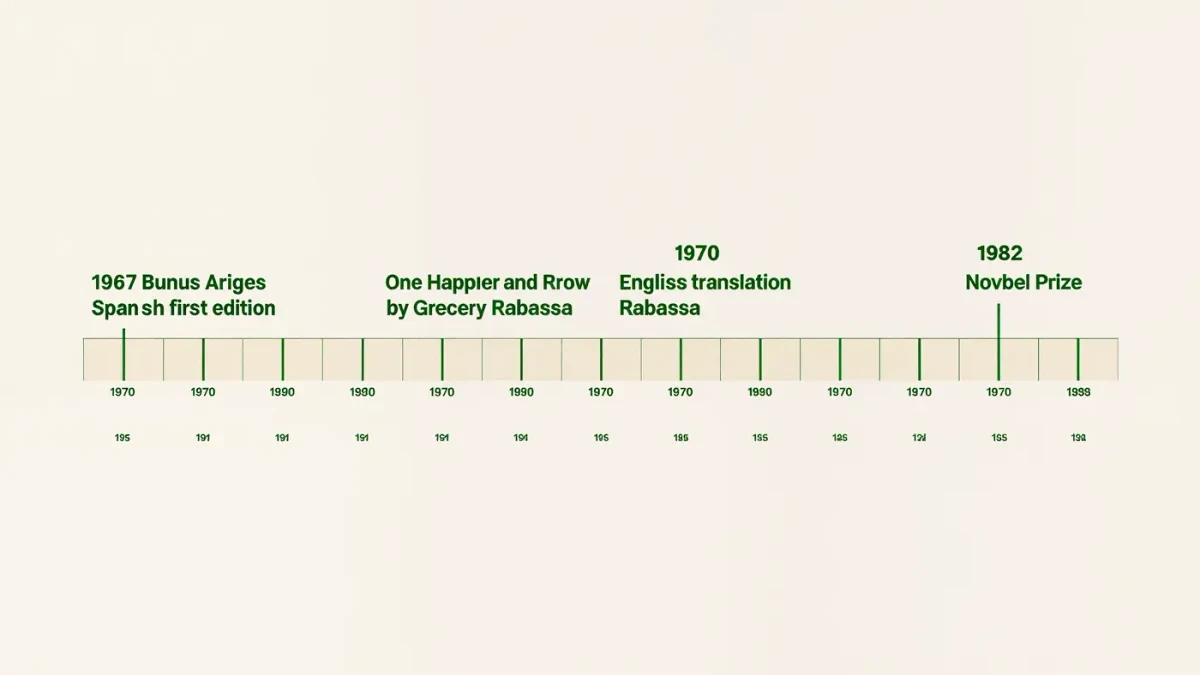
The origin story is canonical. Cien años de soledad appeared in Buenos Aires in 1967 and emptied itself across the Spanish-speaking world with a speed publishers still cite as legend. Rabassa was then the newest name in Latin American translation, fresh from Julio Cortázar's Hopscotch (1966), which took the first National Book Award the American establishment devoted to translation. García Márquez, pleased with what that English had done for a book he admired, decided that only Rabassa would do and held the rights until the translator's calendar cleared. Rabassa, for his part, has described a method that sounds like a stunt and is in fact a discipline: he translates the first draft as he reads the book for the first time, refusing the safety of a second pass, on the theory that a translator, like a reader, meets a book once.
Why did García Márquez call the English version better?
Because the remark, which he repeated in interviews across decades and which Rabassa spent decades politely deflecting, said less about comparative merit than about what each language does to the book's engine. Spanish soledad means both solitude and loneliness; English must choose, and Rabassa's choice of the colder, more architectural word — solitude — tilted the novel away from sentiment and toward myth. The remark is best read as an author's recognition that his translator had understood the register better than the market expected anyone to.
Consider the opening sentence, one of the most quoted passages in postwar fiction: “Many years later, as he faced the firing squad, Colonel Aureliano Buendía was to remember that distant afternoon when his father took him to discover ice.” The sentence holds three times at once — a future execution, a remembered afternoon, a child's first encounter with wonder — and suspends them in a grammar that refuses to rank them. Rabassa's “was to remember” keeps the Spanish future-in-past intact, so that memory arrives before the event it remembers. Every reader who has felt that the novel's time is a loop rather than a line has felt it first in that English verb.
What does Rabassa's translation actually keep?
Nearly all the machinery: the genealogical roll call of Aurelianos and José Arcadios, the repetitions that act as the family's heartbeat, and above all the tone — that of an old man telling the only story he has, flatly, with the wonders priced at zero. What he keeps best is temperature. The novel's famous events — the insomnia plague, the ascension of Remedios, the yellow butterflies — are narrated at the same volume as a recipe, and Rabassa never raises his voice on the author's behalf.
The English is not spotless, and the habit of calling it better than the original should survive that fact. Translation scholars have catalogued small lapses across the text — a softened tense, an echo lost, a Spanish idiom resolved a shade too quickly — and none of them is structural. The structure is the miracle, and it stands: the century of Buendías that closes when the last one deciphers Melquíades' parchments and the page the reader is holding becomes the manuscript. Rabassa's defects are the defects of a first reading, which is to say they are the book's own method applied to itself. His reward was a career as the English voice of the Latin American boom, capped by the PEN/Ralph Manheim Medal in 1982, the year García Márquez took the Nobel Prize in Literature on a reputation built in at least two languages.
Should English readers wait for a new translation?
No. The 1970 text is not a stopgap but the co-canonical version — the one in which the novel's English reputation, its place on syllabi, and most of its imitators' style were actually formed. Retranslating it would be lawful eventually and pointless almost immediately, like repainting a fresco because the plaster has aged. The case for a new version exists on paper: English has moved, and a translator raised on a later idiom might render the book's famous run-on drift differently. But drift is precisely what Rabassa was conserving.
The mistake to avoid is subtler than nostalgia. Crediting the translation with the novel's greatness mistakes a medium for a cause: the greatness lives in the design, the tireless deadpan, the closing trick that turns reading into the crime it describes. What Rabassa proved — and what anniversary retrospectives of the sort gathered by BBC Culture keep rediscovering — is that the design could survive a full change of language with its physics intact. That is not improvement. It is the second-best thing in a translator's art, and rarer.
So reread the English as English. Read the first sentence aloud, then read the last, and notice that both are about a reader arriving too late at a text that was always waiting. Between them Rabassa laid a hundred years of prose at exactly the right temperature, and the room it built is still furnished. A translation that becomes a room is not a copy of the house. It is an annex, and this one has had the guests for fifty years.