A book advance is an up-front payment against future royalties. The publisher pays it once, the author keeps it no matter how the book sells, and no further money is owed until the book earns back what was already paid. That single mechanism — advance, royalty rate, earn-out, reserve — explains most of what writers negotiate and most of what publishers quietly track.
The short version: the advance is the loan, the royalty rate is the repayment schedule, the earn-out is the break-even point, and the reserve against returns is the publisher's brake on paying too early. The rest of this guide walks through each term, and the incentives attached to it, in plain language.
What is a book advance, exactly?
An advance is a pre-payment of royalties, not a bonus on top of them. Signing a book contract does not create a salary; it creates a royalty stream, and the advance is simply the first slice of that stream, delivered early and in installments. It is the publisher's way of moving risk from the writer's checking account to its own balance sheet.
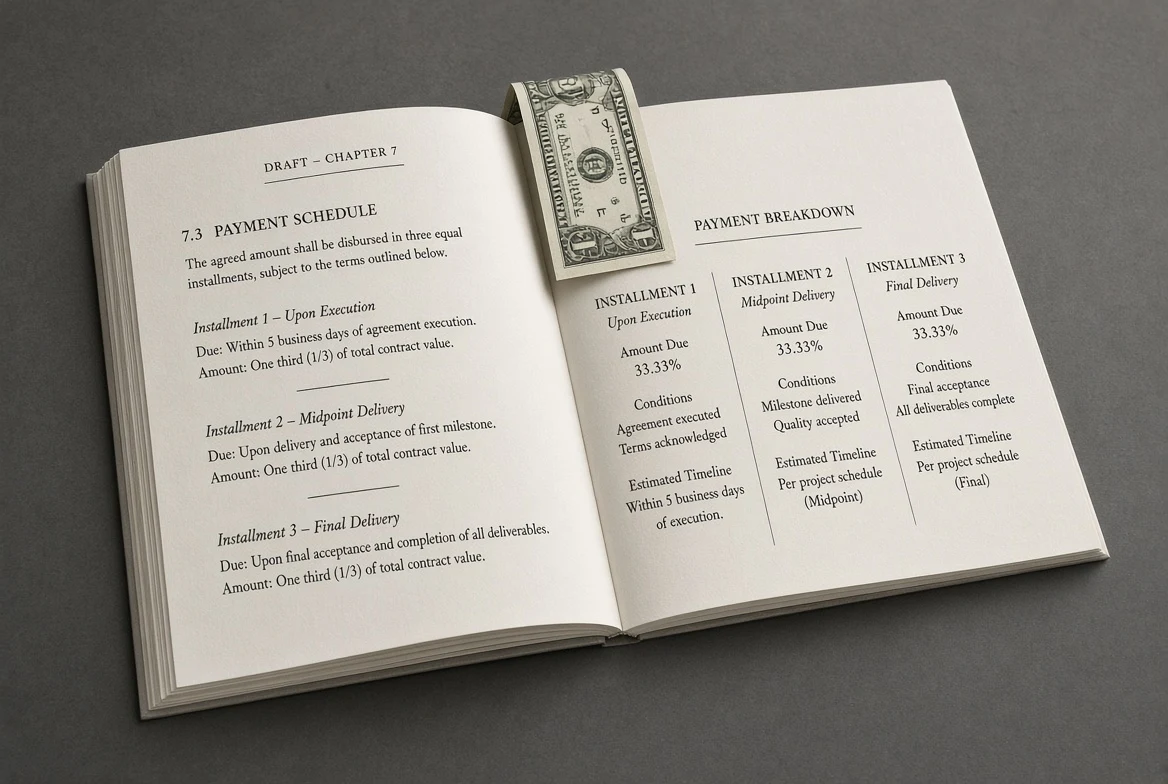
In the United States and the UK, advances are customarily split into installments tied to milestones: a portion on signing, a portion on delivery and acceptance of the manuscript, a portion on publication, and — where a paperback edition is planned — a smaller portion on paperback release. The exact split is negotiable, and smaller houses often pay in fewer, larger chunks. Agents typically take their commission from each installment as it arrives, which is one reason timing matters as much as size.
The most important feature is unconditional: if the book sells poorly, the author does not write a check back. The advance is the advance. Every royalty that accrues afterward goes to the publisher until the ledger evens out.
How do royalties work once the advance is spent?
Every copy sold generates a royalty — a percentage of either the list price or the publisher's net receipts, depending on the contract — but the publisher holds those earnings until they equal the advance paid. Only after the book has earned out does the author begin receiving royalty payments, typically on a twice-yearly accounting schedule with a lag of several months.
Rates vary by format and market. Hardcovers generally earn royalties in the low-to-mid teens as a percentage of list, with escalators once sales cross agreed thresholds; paperbacks earn less. Ebook royalties are the outlier: many US trade contracts reportedly peg them at about a quarter of net receipts, a figure that has been a running source of friction between agents and houses. UK contracts often build royalties on sliding scales by sales band instead.
Two accounting lines confuse newcomers more than any others. The first is the reserve against returns, covered below. The second is the earn-out line itself — the running total that tells you how close the book is to paying actual money again.
What does earning out actually mean?
Earning out means cumulative royalties have caught up with the advance. It is the break-even line on the author's royalty statement: below it, the statement shows nothing owed; above it, payments resume. Publishers read the same line as a live signal of how a book is tracking against internal expectations.
A persistent misconception is that earning out is the publisher's profit line. It is not. The house's economics include its own margins on each sale, so a book can fail to earn out and still have made the publisher money — a fact editors repeat often, usually while declining to say by how much. What earn-out reliably measures is momentum: whether the sales curve is consistent with the bet that was placed.
That is why agents watch the earn-out rate even on books that never cross the line. A slow, steady crawl toward break-even is a better argument for the next contract than a large advance followed by silence.
Why doesn't a big advance mean big sales?
Because the advance is a bet, not a forecast. It reflects competitive tension — an auction, a hot submission, a house protecting a relationship — more than any predicted number of copies. The bigger the check, the higher the bar the book must clear to be remembered internally as a success.
Auctions are the classic distorting mechanism. When multiple houses want a book, the price rises to whatever the second-most-enthusiastic editor can justify, a number that may have little to do with the eventual audience. Seven-figure advances for a handful of titles make headlines; most literary novels are bought for far less, and mid-list advances remain the industry's center of gravity. The economics of bidding wars and consolidation are standard business coverage for outlets including Bloomberg.
The other half of the bargain is attention. A large advance usually arrives with a marketing commitment, since the house needs the book to work. But marketing converts at no guaranteed rate, and expensive bets fail publicly — which is why publishers hedge across a whole list rather than staking the season on one title.
What is a reserve against returns?
A reserve against returns is money the publisher withholds from royalty earnings to cover copies that bookstores may send back unsold. Retail in both the US and the UK buys stock on a returnable basis, so a portion of royalties is held back and released in later accounting periods, once unsold copies have stopped flowing back to the warehouse.
On a royalty statement the reserve appears as a deduction from earned royalties — a percentage estimate that looks alarming until it reconciles. Authors near an earn-out boundary sometimes discover that the reserve, not weak sales, is what kept a check from arriving. The mechanics are standard; the timing is what frustrates.
How should a debut author read a first advance?
As a working budget and a scoreboard at once. A modest advance that earns out builds a stronger negotiating position for the next book than a large one that stalls, because publishers remember which bets paid off. The advance is the beginning of a relationship's arithmetic, not the end of it.
Practically: ask what the earn-out requires in copies, ask when installments land, and remember that taxes and any splits come off the top. A first book's job is less to make money than to make a record — of sales velocity, of an audience that showed up, of a writer who delivers. The second contract is negotiated with that record in hand.