Two writers from Wyoming published books on American Christianity in the same month, and the pairing is more instructive than coincidence. According to Cincinnati Magazine, Jason Hentschel, pastor of Wyoming Baptist Church, brought out Desiring Certainty: The Making of Biblical Inerrancy (Eerdmans Publishing), while his neighbor Sarah Stankorb, a professional journalist, published Damned If She Does: Why Women Quit Church and What It Means for the Future of Religion (Broadleaf Press). Both appeared in September. They will discuss the books together at 7 p.m. November 10 at Wyoming Community Coffee.
What the pairing means, read as one argument rather than two, is this: American Christianity's current turmoil is not primarily a fight over belief but a fight over authority — who gets to claim it, on what grounds, and what happens to the people on the receiving end. Art News rarely touches religion publishing, but this story belongs to the same economy of books, talks and local readership that shapes everything else on the shelf. Readers following this should also see Heavy Volumes: Inside Art Book Publishing.
Hentschel's book is the historical half of that argument. Inerrancy — a term he defines in the interview as the claim that the Bible is without error in everything it teaches — is usually debated as a doctrine. His project treats it instead as something made. Stankorb, who has read his work for years, describes the book in the magazine's exchange as "a highly readable history that helps unwind the mystery for a lot of us about how we got here," one that shows "the conflict between ideas and the tensions that grew inside the faith" while keeping "some patience and compassion" for why people want certainty about God so badly. The framing matters: a pastor writing the biography of his own tradition's most potent claim, rather than defending it. This connects to our earlier piece, The Shelf Rent: How Bookshop Margins Actually Work.
What inerrancy does, not what it is
Hentschel's own summary in the interview is the sharpest line either writer offers. "The big issue today surrounding biblical inerrancy is not what inerrancy is but what inerrancy does," he says. What it does, in his account, is "write off other voices and other perspectives on Scripture and Christian faith as aberrant without actually listening to what they have to say." He adds that this "weaponization of Scripture" has hit women and minorities hardest, because it typically upholds "a white, patriarchal view of reality."
That is a notable admission from inside the pulpit. A pastor with a PhD in Theology from the University of Dayton — a credential the magazine notes — is arguing that the framework he serves professionally has been used to silence the people he serves. The analysis turns doctrinal history into a story about power, which is exactly the move that makes the two books cohere.
The view downstream
Stankorb's book supplies the human ledger that Hentschel's history lacks by design. Her reporting, per the magazine, explores why women leave the church and how they are mistreated within it. Her own phrasing is civic in the plainest sense: "I think in my reporting I'm downstream from the consequences of what happens when that authority is claimed by the wrong people."
Hentschel reads her the same way. "Those are just numbers," he says of the demographic talk that fills church meetings — who is coming, who is going. "Sarah invites us to meet the real people behind those numbers, and those real-life stories change everything." His verdict on his own response: "I left this book eager to be a better pastor, but most of all I left this book eager to be a better listener."
A shared diagnosis: the crisis of truth
Asked what pattern both books address, Stankorb names it directly. Both, she says, confront "different aspects of our current crisis of truth" — an information age of deep fakes and data without wisdom, in which "authoritarian, Christian nationalism with in-built claims to inerrancy" has absorbed so much attention that many people take it for the whole of Christianity. "It doesn't," she writes.
Her proposed alternative is procedural rather than theological: shift authority to "a community-based model," where dialogue can test "whether belief is based in faith or logic or fear." Her sources, she reports, describe "a certain lightness" in searching after years of being told what to believe. Both books, she argues, open paths for a pluralistic country to find community across different beliefs.
Why a coffee shop matters
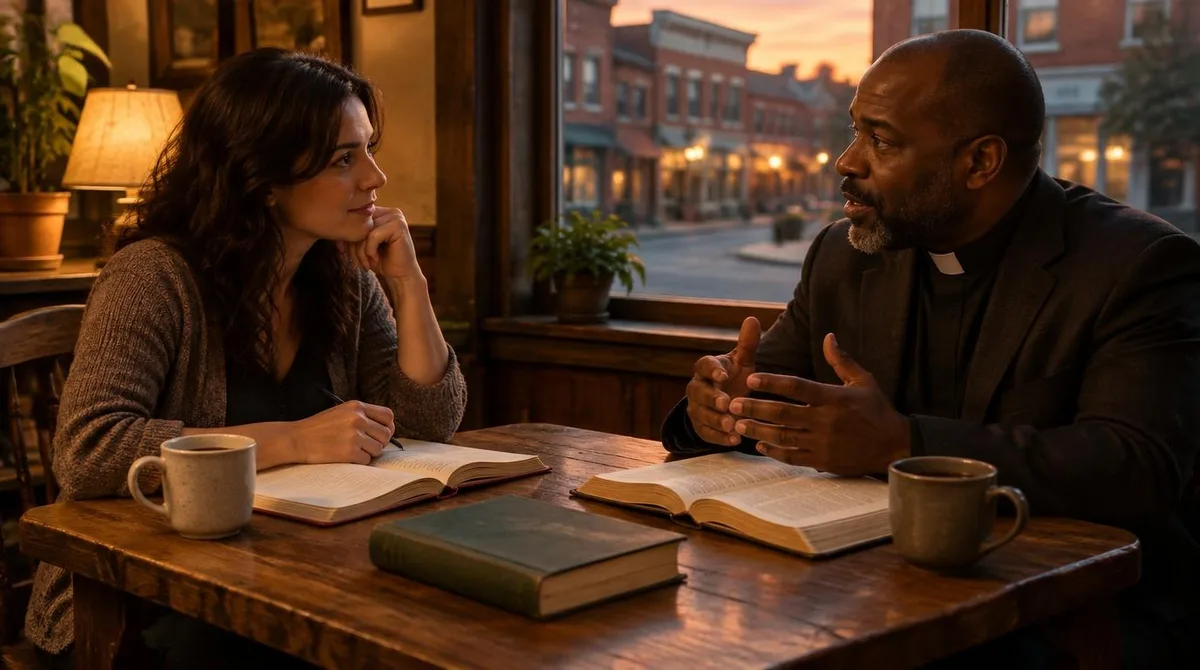
The November 10 event itself is the smallest fact here and arguably the most telling. A pastor and a professional journalist, neighbors who have read each other for years, staging a joint talk in a local coffee house models the exact practice both books prescribe: conversation across a split that national discourse treats as unbridgeable. Stankorb's playful answer about where the books would dine — Mellotone, the Over-the-Rhine brewpub housed in the old St. Paul's German Evangelical Protestant Church, where her book would order the house Unlimited Devotion pilsner — carries the same point in jest: even the venues are conversions.
What the evidence establishes is a local case study of a national argument: one book explaining how a doctrine of certainty was built, the other documenting what that certainty costs the people under it. What remains unknown is whether the community-based model Stankorb proposes can hold at scale, or whether it works only at the size of a neighborhood, a church basement, a coffee shop at 7 p.m. on a Monday. The books, for now, argue the case. The readers in Wyoming get to cross-examine.