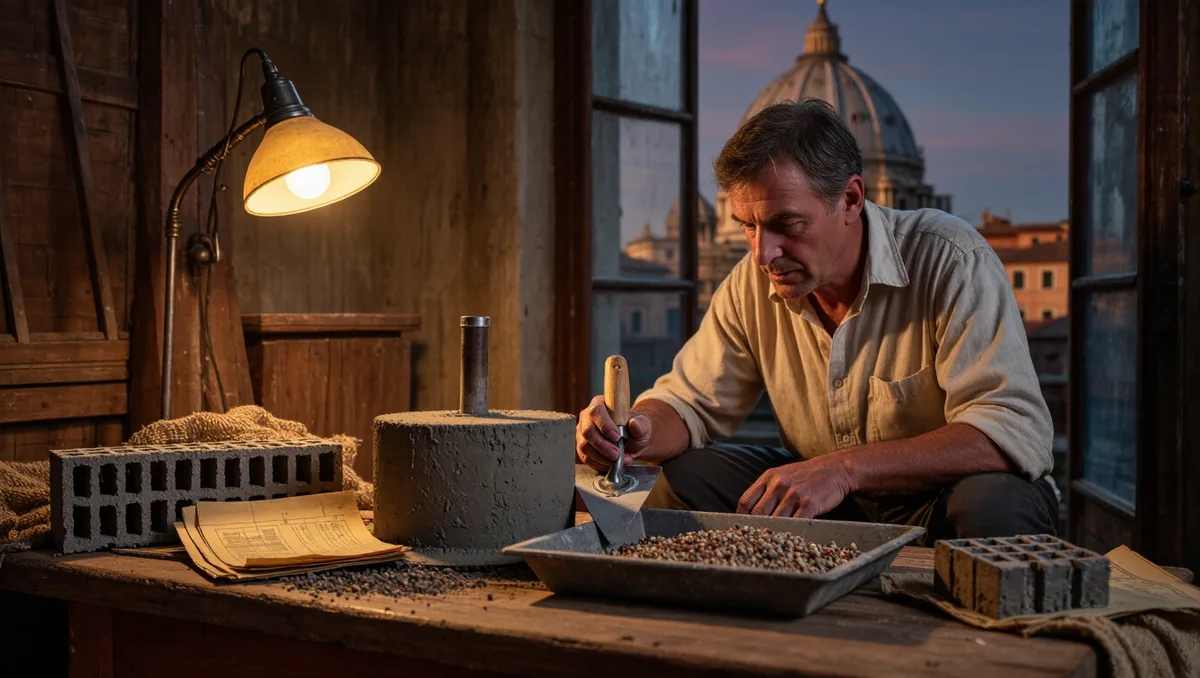
Concrete built civilization twice. The Romans mixed it, and their domes and harbors reshaped the ancient world. Then, after centuries of forgetting, builders rediscovered the recipe, and the modern city became possible. The history of concrete is not a sidebar to human history. It is the ground under it.
What makes the material so consequential is a simple trick: it starts as a liquid and ends as a stone. Mix water, an aggregate like gravel, and a binder that reacts with the water, and you get something that can take any shape a carpenter can frame. That shapelessness is its cultural power. Concrete let people pour their ambitions into forms that brick and timber could never hold.
This piece follows the material from ancient harbor works to the modern skyline, and asks a question this site keeps returning to in its material histories of paper, ink and bindings: what does a physical substance do to the culture that depends on it? As with our piece on The Wood Pulp Break: How Cheap Paper Remade the Nineteenth Century, the answer is that a cheap, abundant material quietly rewrites who can afford to make things. For related coverage, see The Wood Pulp Break: How Cheap Paper Remade the Nineteenth Century.
What is concrete, and why did it matter so much?
Concrete is a composite: loose stone held together by a paste that hardens around it. The hardening is chemical, not just drying. That distinction matters, because a dried mud brick softens again in rain. A chemically cured binder does not. Once builders had a material that could set underwater, hold any shape, and grow stronger over years, the practical limits of construction moved from the quarry to the imagination.
The material also mattered because it is forgiving of labor. Cut stone demands trained masons working for years. Concrete demands forms, mix, and hands. A community that could not afford a cathedral of dressed stone could still pour a cistern, a bridge abutment, a floor. In that sense, concrete has always been a democratic material, even when empires used it for monuments.
How did the Romans make concrete work, and why was it forgotten?
Roman builders mixed lime, volcanic ash, and rubble into a binder that could cure even beneath the sea. Mediterranean harbor works made with it still survive. The volcanic ash was the secret; it gave the mix a durability that later centuries struggled to match. The Pantheon's vast unreinforced dome remains the standard argument for what the material could do when the engineering was confident and the money was imperial.
Then the knowledge thinned. It is tempting to say Rome "fell" and took its concrete with it, but the truer story is quieter. The recipe depended on specific volcanic materials and on large, organized works projects. When the projects stopped and the supply lines shortened, the skill stopped being practiced. Building knowledge lives in crews, not in books, and crews disperse. For centuries afterward, European builders worked in stone and brick, and a material the ancients had poured by the ton became, in effect, a lost technology.
That pattern is worth dwelling on, because it recurs across the history of making. Techniques survive by use, not by record. Our piece on How History Repeats Itself: Patterns Historians Actually Study describes how historians look for these recurring structures rather than single events, and the rise, loss and rediscovery of a building technology is one of the oldest such structures there is. We covered a connected angle in How History Repeats Itself: Patterns Historians Actually Study.
How did modern concrete come back?
The rediscovery came in pieces, through the eighteenth and nineteenth centuries, as engineers studied hydraulic limes that could set in wet conditions. The decisive step was a manufactured binder, made by burning limestone and clay together and grinding the result into a powder. Add water and it becomes the paste that makes modern concrete. This manufactured binder is what turned a craft recipe back into an industry.
Reinforcement was the other half of the comeback. Concrete handles squeezing forces well and pulling forces poorly. Bury steel bars inside it, and the steel takes the tension while the concrete takes the compression. The two materials expand and contract at roughly compatible rates, so they work as one. Reinforced concrete is what made the modern frame possible: floors that span wide rooms, columns that rise story after story, structures poured rather than stacked.
For readers of a books publication, the parallel is exact. Reinforced concrete did to building what cheap paper did to reading. It dropped the cost of the basic unit, and whole new forms appeared. The skyline of the twentieth century, like the paperback rack, is the visible signature of a materials revolution.
What does concrete reveal about the societies that pour it?
Concrete is honest about priorities. You can read a government's self-image off what it chose to cast: aqueducts and amphitheaters in one era, housing blocks and highways in another. Because concrete is cheap in bulk, it is the material of mass projects, and mass projects are where a society's values show at full scale. The material carries no style of its own. It takes the imprint of whatever form it is poured into, which is why debates about concrete are almost never about the material itself. They are about the forms we chose.
Its durability is also selective, and that selectivity is a historical fact worth sitting with. Some ancient works have outlasted nearly everything built since. Some modern construction, poured far faster and cheaper, ages badly. Longevity, it turns out, is not a property of the material alone. It is a property of the recipe, the care, and the patience of the people who used it. A civilization's concrete record tells you how long it expected its decisions to matter.
There is a maintenance story here too, and it is a community story. Concrete does not demand attention for a long while, and then it demands a great deal. The public realm built of it, the steps, the plazas, the underpasses, ages on a timetable set decades earlier by people who never met the people who use it. Anyone who has sat through a folding-chair meeting about a crumbling neighborhood facility knows that the history of concrete does not end at the pour. It continues in every budget cycle since.
What this means for readers today
Our analysis is this: concrete belongs in the same conversation as paper, print and binding, the unglamorous technologies that decide what a culture can physically do. A material that is cheap, moldable, and strong enough will be used everywhere, and its strengths and failures become everyone's daily environment. The history of concrete is the history of that environment being chosen, usually by people whose names did not make it into the record.
What remains unknown is the material's next chapter. Builders now face real pressure to rethink a substance whose production carries a heavy environmental cost, and the search for better recipes is ongoing. Whatever replaces or reforms it will be judged the way the Roman mix and the modern frame are judged: by what it lets people build, and by how long the building stands. The past suggests the answer will arrive the way the last two did, quietly, on a job site, long before anyone writes it down.
For a broader map of the period in which the material's story begins, the topic pages at HISTORY group Ancient Rome among the major chapters of the human past, a useful reminder that the story of a building material runs straight through the story of empires.