Paper became cheap when printers stopped waiting for rags: in the early 1840s the German inventor Friedrich Gottlob Keller worked out how to grind wood into pulp, and wood-pulp paper — cheap enough to burn through by the ton — reached mass production in the 1850s. Cheap paper arrived decades before cheap books, and it rebuilt newspapers and fiction first.
Paper was the binding constraint on print for four hundred years — a constraint felt in every edition size and cover price. Gutenberg’s press could multiply text; it could not multiply rags. Until the nineteenth century, paper was made from recycled linen and cotton, and every expansion of publishing ran into the same wall: Europe produced only so much worn-out cloth. The industrialization of paper waited on a new fiber, and found one in trees.
Why was paper made from rags for so long?
Because rag fiber worked and nothing else was known to. Papermaking spread from China through the Islamic world into Europe by the twelfth and thirteenth centuries, and its recipe — macerated linen and cotton rag, suspended in water, lifted on a mould — remained effectively unchanged for five hundred years. Print raised demand; the rag supply could not follow.
By the eighteenth century the shortage had a name, the rag famine, and paper cost enough to shape publishing: editions stayed small, newspapers stayed expensive, and worn shirts and old sails were serious industrial commodities, traded and adulterated. The papermaking machine — Nicolas-Louis Robert’s invention of 1798, industrialized in England by the Fourdrinier brothers and Bryan Donkin in the 1800s — accelerated production without solving fiber. A faster mill merely waits faster for rags.
Experiments with substitutes ran for decades — straw, nettles, wood treated as a curiosity — before anything scaled. The problem was not imagination but mechanics: fiber had to be separated cheaply, in bulk, without hand sorting. Two solutions arrived in the same decade, one mechanical and one chemical, and paper entered its petroleum moment — a feedstock switch that reset the price of everything downstream.
Taxation amplified the constraint in Britain, where newspaper stamp duties and a duty on paper — the “taxes on knowledge” — kept papers dear until the advertising duty fell in 1853, the stamp in 1855 and the paper duty in 1861. Cheap fiber and fiscal relief arrived in the same decade, which is why the 1860s read, in retrospect, as the hinge of the whole story.
How did wood pulp make paper cheap?
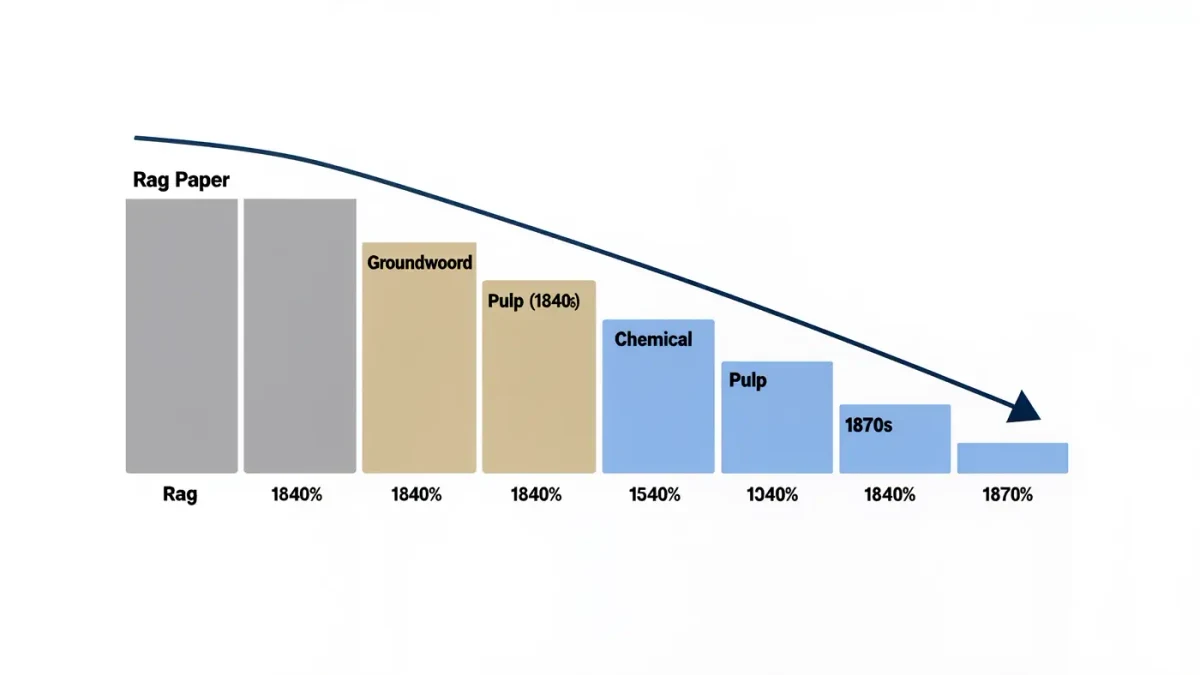
By attacking the fiber cost directly. In the early 1840s Friedrich Gottlob Keller, a Saxon craftsman, devised a process for grinding softwood against a stone into pulp; patented in the mid-1840s and industrialized by Heinrich Voelter’s machines in the 1850s, groundwood turned trees into paper stock at a fraction of rag cost.
The idea occurred twice, as happens: in 1844 Charles Fenerty of Nova Scotia described making paper from ground wood in a letter to a Halifax newspaper, without patenting anything. Keller sold his rights cheaply and regretted it; Voelter built the industry. Chemical pulp followed — soda processes, then Benjamin Tilghman’s sulfite work in the 1860s, commercial by 1874 — dissolving the wood’s binding lignin for stronger, whiter stock that carried fine printing as groundwood never could.
| Year | Development |
|---|---|
| 1798 | Nicolas-Louis Robert patents the papermaking machine |
| early 1840s | Keller’s groundwood pulp experiments in Saxony |
| 1844 | Fenerty’s letter to a Halifax newspaper |
| 1850s | Voelter’s grinding machines industrialize groundwood |
| 1860s-1874 | sulfite chemical pulp developed and commercialized |
| 1880s | wood-based stock standard for newsprint in the industrialized world |
What did cheap paper change first — and what not?
Publications sold on volume, not books. Newspapers and magazines converted to wood-pulp stock through the 1860s and 1870s, and big-city dailies grew to circulations in the hundreds of thousands by the 1890s. The dime novel — Beadle’s series from 1860 — and mass monthlies followed. Books stayed cloth-bound and relatively expensive for decades.
Demand, notably, had outrun supply before the fiber arrived: the American penny papers of the 1830s built mass circulations on rag paper — thin margins on a scarce input — and waited on the 1840s to make the model breathe. Circulation was not created by cheap paper; it was uncapped by it.
The lag is instructive. Paper is one cost among binding, distribution, warehousing and retail, and the codex as an object resisted cheapening longer than the page inside it. Cheap paper made reading matter disposable a generation before it made books disposable — the newspaper got thrown away in 1870 while the novel on the shelf remained a purchase. The economics are familiar from every media market since: when the marginal cost of a copy collapses, volume businesses reorganize around it, and the reorganization favors whoever can move the most paper fastest.
What was the hidden cost of cheap paper?
Permanence. Groundwood carries lignin, and the alum-rosin sizing used with it turns acidic; paper made from the 1870s onward can embrittle until a page breaks at a touch. Libraries spent the late twentieth century deacidifying and reformatting millions of volumes. Rag-paper books of the 1450s are often supple by comparison.
Which is the trade in full: the fiber switch bought abundance and paid for it in permanence, moving print from heirloom to consumable. Keller’s grinding stone sits in museum collections beside the presses it fed — the least glamorous object in the history of books, and among the most consequential. Every cheap paperback of the twentieth century, every mass-market everything, descends from a Saxon workshop and a Canadian letter that agreed, without consulting each other, that trees could do what rags no longer could.