The Book of Kells (c. 800) is an illuminated Gospel book, painted on calfskin by Irish monks and kept at Trinity College Dublin since 1661. It survives in 340 folios, of which the most famous — the Chi Rho page, folio 34r — turns the first two Greek letters of “Christ” into a page-wide thicket of ornament.
The manuscript is usually introduced as the most beautiful book in the world — a critical claim wearing a superlative, and defensible mainly because the book declines to argue. Its 340 surviving folios carry the Gospels in Latin through a density of interlace, animal forms and enlarged initial pages that has few parallels in Western manuscript painting before or since. What is known with confidence about it is modest; what is argued about it fills libraries.
What exactly is the Book of Kells?
A Gospel book: the four Gospels of the Latin Vulgate, with canon tables and prefaces, written and painted on calfskin around the year 800, in the Insular style of the Irish monasteries. It survives in 340 folios — 640 pages — a few quires short of the original, and several distinct hands are visible in its script and decoration.
The physical facts alone explain the devotion. The folios measure about 33 by 25 centimeters; the skins of well over a hundred calves went into the making; and the surviving text shows scribal slips left standing — repeated lines, omitted words — while the decoration received care without visible limit. The workshop’s priorities are legible twelve centuries on: ornament outranked textual accuracy, and everyone involved evidently agreed. Scribes copied; painters exalted; nobody went back to fix the Latin.
The Gospels are framed by apparatus as decorated as the text: canon tables — the concordance system devised by Eusebius — open the book under painted arches, and a handful of full-page images punctuate the whole. Among them, folio 7v carries the Virgin and Child with angels, often cited as the earliest surviving Madonna in Western manuscript illumination — an image of quiet authority set, characteristically, at the threshold rather than the center. Even the preliminary lists of Hebrew names received ornamental framing; nothing in the book was left plain, down to the great decorated initials that open each of the four Gospels.
Where was it made, and when?
At the monasteries of the Columban tradition, probably begun on the island of Iona and completed at Kells in County Meath, in the years around 800 — late eighth century to early ninth by scholarly convention. Viking raids on Iona in 795, 802 and 806 pushed the community inland, and Kells was refounded around 807.
Its later biography is eventful for a Gospel book. The Annals of Ulster record its theft in 1007 — the great Gospel of Colum Cille, wickedly stolen by night, recovered after two months minus its jeweled cover, which was never seen again. It remained at Kells into the seventeenth century, when Henry Jones, Bishop of Meath, sent it to Trinity College Dublin, its home since 1661. The cover’s loss is the manuscript’s second wound; the first was time itself, which took quires now counted only by their absence.
What is the Chi Rho page?
Folio 34r, the most famous page in early medieval art. At the Nativity passage in Matthew — Christi autem generatio — the scribe inflates the Greek letters Chi and Rho, the first two of Christ’s name, into a page-filling composition of interlace, animal forms and abstract coils that swallows three lines of text.
The page repays any magnification: animals peer out of the knots, and the count of identifiable creatures and decorated elements keeps growing with each generation of study. Reproduction flattens its fame into pattern; the object itself is close-work, designed for slow reading at close range in poor light. Monks who never saw the finished book in reproduction spent years of eyesight on passages smaller than a thumbnail — the fact most often cited, and most often disbelieved, in the scholarship.
Where is the Book of Kells kept — and how much can you see?
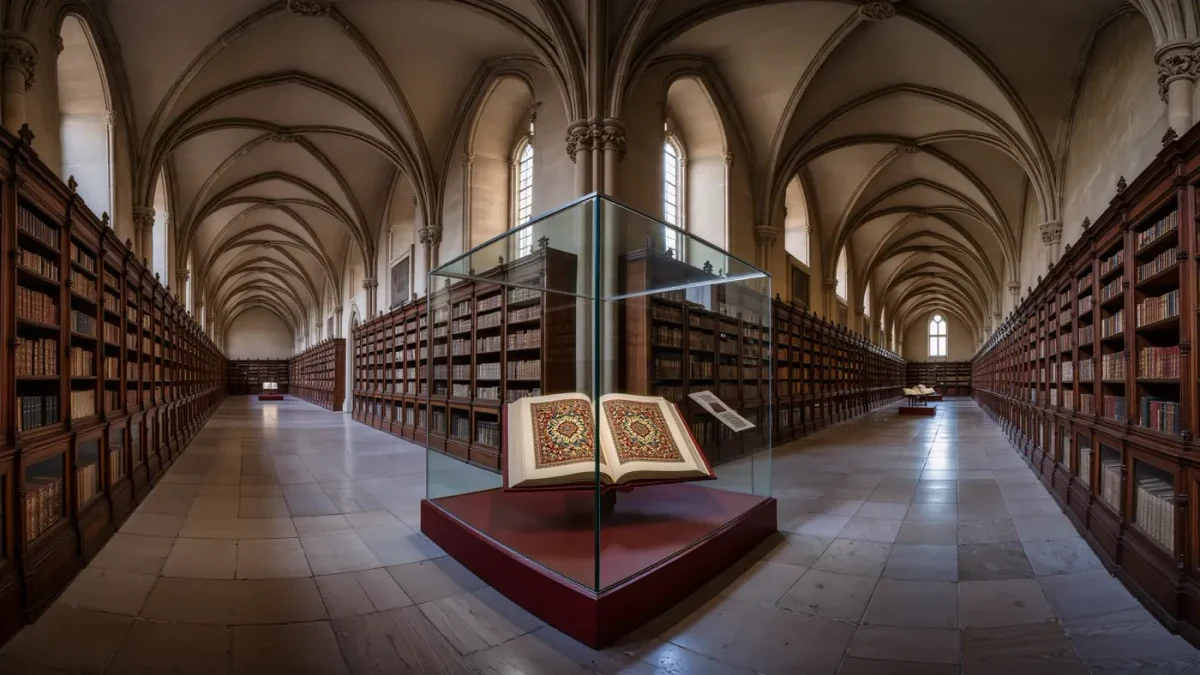
At Trinity College Dublin, in the Old Library, since 1661. A 1953 rebinding divided it into four volumes; two are displayed at a time, open at a few pages that are turned at set intervals, and a digitized copy is available online. Visitor numbers run to the hundreds of thousands a year.
The exhibition economy around one manuscript — queues, retail, postcards — would have bemused its makers, though not for the reasons usually assumed: they built it as a shrine object, a thing whose point was precisely that it was not ordinary. The cultural tourism it anchors is the modern version of pilgrimage; the book has simply never stopped being a destination. Turning the pages at intervals is the curator’s compromise between exhibition and conservation, and the digital copy is the monkish copyist’s revenge — multiplication without wear.
What is known with confidence about the Book of Kells fits in a paragraph: date to within a generation, place to within two monasteries, purpose to a liturgical and prestige object of the Columban community. Everything else — the meanings of its ornament, the number of its artists, the sequence of its making — remains argued over, which is the honest condition of medieval art history and part of the book’s hold on anyone who stands in front of folio 34r for longer than a photograph requires.