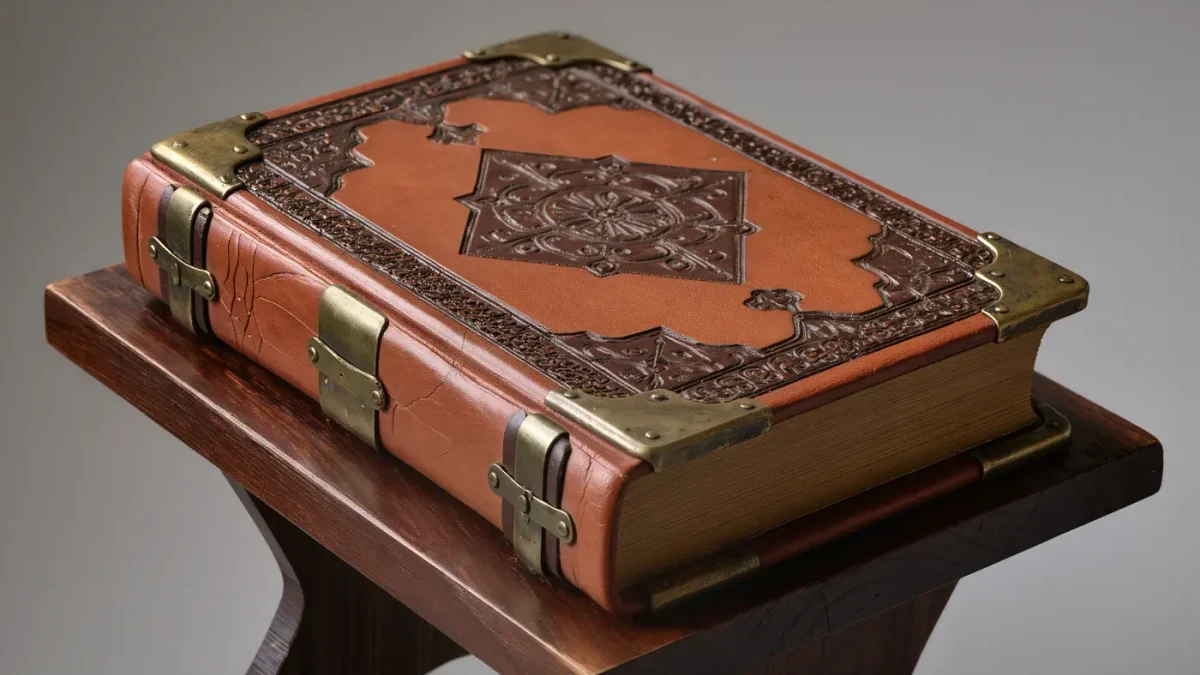
The first book printed in English North America was The Whole Booke of Psalmes — the Bay Psalm Book — issued at Cambridge, Massachusetts, in 1640 on a press run by Stephen Daye, a locksmith by trade. Some 1,700 copies were printed; eleven survive, and in 2013 one of them sold at Sotheby’s for about $14.2 million.
Firsts are usually accidents, and this one was theological. Massachusetts congregations sang psalms from metrical translations brought from England and found them poor — neither faithful to the Hebrew nor good to sing. A committee of ministers produced a new translation, and a press that had reached the colony two years earlier produced the book. Printing history was a side effect of liturgical dissatisfaction.
What was the first book printed in America?
The Bay Psalm Book — printed at Cambridge, Massachusetts, in 1640, in full The Whole Booke of Psalmes Faithfully Translated into English Metre. It was the first book printed in English North America and the first surviving product of the colonial press; two 1639 imprints, a broadside oath and an almanac, are known only by reference.
The continental title belongs elsewhere: printing began in the Americas at Mexico City in 1539, and presses followed across South America within decades. What the Massachusetts claim carries is lineage rather than priority — the 1640 psalter stands at the head of printing in what became the United States, and every American imprint since is, bibliographically, its descendant.
The press’s first products were evanescent by design. The Freeman’s Oath, a single-sheet official formula, and an almanac for 1639 survive in no copy at all; they are known from references in colonial records. The psalter, built for hard use in meeting houses over decades, is the earliest witness that the press existed at all — 1,700 copies printed, eleven accounted for nearly four centuries later.
Who printed it, and with what?
Stephen Daye, a locksmith by trade, working a press shipped over by the clergyman Jesse Glover, who died on the Atlantic crossing in 1638. The press was set up in Cambridge in the house of Henry Dunster, president of Harvard College, and Daye — evidently learning the trade as he went — delivered the psalter in 1640.
How a locksmith came to run British America’s first press is a story of collateral obligations. Daye sailed in connection with Glover’s enterprise, and when the patron died mid-voyage, the debt-shaped arrangement left the craftsman operating equipment he had never trained on. The typography is exactly what that biography suggests: serviceable, endearing, unrefined. Cambridge remained the colony’s printing center for decades afterward, and Harvard grew around the machine.
Why did the Puritans need their own psalter?
Because the English metrical psalters they had satisfied them neither as translations nor as poetry. A committee led by Richard Mather, with John Eliot and Thomas Welde, re-rendered the psalms from Hebrew, choosing fidelity to the sacred text over meter and rhyme — and said so plainly in the preface, conceding that the verses wanted polish.
The result ranks among the least lyrical bestsellers in publishing history: lines that scan backwards, rhymes abandoned mid-stanza, the whole justified as obedience — God’s words were not to be improved for singing. Congregational singing by the whole assembly was the theological point, and aesthetics were explicitly sacrificed to it. The edition stayed in use through revisions and reprintings for more than half a century, its descendants outliving the colony that made them.
How did one copy become a $14.2 million book?
Scarcity, symbolism and a willing seller. Old South Church in Boston, which held two copies, consigned one to Sotheby’s in November 2013; the financier David Rubenstein paid about $14.2 million — still the auction record for any printed book — and said he would lend it for public display rather than keep it private.
The price trajectory is its own chronicle of American book values. A copy brought $151,000 in 1947 — a record then, too. Six decades of institutional lock-up later, the 2013 sale repriced the category entirely, at well over a million dollars per surviving copy of an edition that had been priced, by the usual account, at about twenty pence when new.
Most of the eleven will never test the market again: institutions do not sell, and the church kept its second copy. The dispersal that matters happens in reading rooms instead — the Library of Congress, which holds a copy, has long exhibited early American printing among its rare-book displays, where the psalter’s plain pages are permitted to be unimpressive. That is the honest presentation: an ordinary object that happens to be first.
Where are the eleven surviving copies?
Almost entirely in institutions, weighted toward New England. Old South Church retained its second copy; Harvard and Yale each hold copies; the Library of Congress, the Huntington Library and the John Carter Brown Library hold others. The Rubenstein copy, lent for exhibition, is the one copy in private hands — a census effectively stable for decades.
The Bay Psalm Book’s market value is a valuation of provenance, not of literature; nothing inside it is readable for pleasure by anyone but a specialist. What the $14.2 million purchased is a foundation document — the moment a colony of some twenty thousand people decided it needed its own press and put it to work on the book it sang from. Firsts cost whatever collective memory costs, and in 2013 the figure was written down.