Illuminated manuscripts are handwritten books decorated with gold and silver, and the beginner's path into them runs through one genre: the Book of Hours, the bestseller of the late Middle Ages. Calendar, psalms and marginal creatures survive by the thousands in museum collections, many of them viewable online in high resolution.
What makes a manuscript illuminated?
Gold, worked by hand. Illumination refers to the application of gold and silver leaf, burnished until it catches candlelight; the term bleeds outward to painted decoration generally — historiated initials, borders, miniatures — executed in egg tempera and pigment on prepared parchment or vellum.
The word is a small etymological joke. "Miniature" descends not from smallness but from minium, the red lead used to outline painted scenes; illumination itself comes from the Latin illuminare, to light up — a technical term for metal leaf that reads like a metaphor. Production was a chain of specialists: the parchmenter prepared skins, the scribe ruled and copied, the rubricator marked structure in red, the illuminator painted, the binder assembled. By thirteenth-century Paris, that chain had become an urban trade with workshops, stock images and delivery dates — a publishing industry before print.
Why is the Book of Hours the place to start?
Because it was the bestseller of its age. The Book of Hours was a private devotional manual — psalms, prayers and readings arranged by the canonical hours — produced by the thousands in the fourteenth and fifteenth centuries, more than any other illuminated genre, and owned by readers beyond clergy and court.
Its architecture is regular enough to learn once. A calendar opens the volume, listing saints' days and illustrated with the labors of the months and the signs of the zodiac — January feasting, June mowing. The Hours of the Virgin follow, eight services from Matins to Compline, each illustrated with scenes from the life of Mary; penitential psalms, a litany and the Office of the Dead close the core. Owners personalized the frame: heraldry, portraits of patrons kneeling, locally beloved saints added to the suffrages.
The summit of the genre is Très Riches Heures (c. 1412–1416), painted by the Limbourg brothers for Jean, duc de Berry, and preserved at Chantilly — a book whose calendar pages arguably taught later centuries what the medieval year looked like. But the genre's typical productions matter more to the beginner: modest hours made for townspeople, worn by use, and survivable in numbers that grand commissions never were. More Books of Hours survive than any other type of illuminated manuscript, which is precisely why they are the learner's genre.
What is happening in the margins?
Mostly mischief. Marginalia — grotesques, hybrid animals, combative figures, knights fighting snails — form a counter-text running along the painted border. Scholars dispute whether drolleries are pure diversion, mnemonic devices or licensed inversion of the solemn page; the margins rarely explain themselves.
The bestiary is consistent enough to recognize quickly: rabbits in armour, monkeys at desks, bishops sprouting foliage, dignified men defeated by molluscs. Several scholarly schools have claimed them — as comedy, as sermon illustration, as a theory of reading — and none has fully won. For the beginner the margins are the friendliest door into the manuscript, precisely because they ask to be interpreted rather than identified.
Where can a beginner actually see them?
In the digital reading rooms of the great libraries. The British Library's Digitised Manuscripts, the Bibliothèque nationale de France's Gallica, the Morgan Library and the J. Paul Getty Museum all publish high-resolution photography of complete manuscripts; the Metropolitan Museum of Art's Open Access stream adds detached leaves.
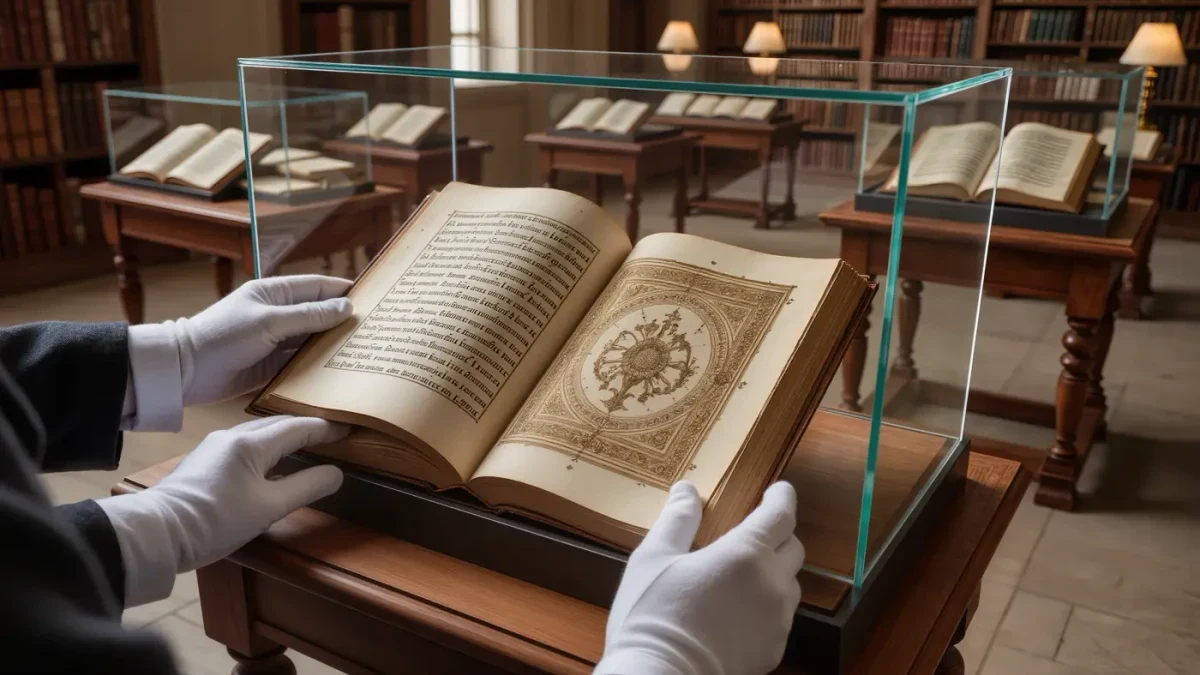
The practical advice is to browse by structure, not by beauty: open any Book of Hours at its calendar and read the month, then follow a single office across several manuscripts and watch the imagery shift. Zoom matters more than the beauty shot — deep zoom reproduces what the eye does in the room. In galleries, light discipline rules: parchment exhibitions run short rotations at low light levels, so displayed leaves change several times a year. Online, the Smithsonian's collections and the Library of Congress's digitized manuscripts extend the same habit of slow, close looking.
How can you tell an original leaf from a facsimile?
Look at the material, then at the pattern. Original vellum shows follicle patterns, a difference between hair side and flesh side, and cockling; burnished gold sits slightly raised and develops minute craquelure. A facsimile prints everything flat, with halftone dots visible under a loupe and no pricking holes.
The question is not academic. Twentieth-century dealers broke hundreds of hours and dispersed their leaves — Otto Ege's mid-century portfolios of "original leaves from medieval manuscripts" are the canonical example — and loose leaves circulate at auction beside printed facsimiles, honestly and otherwise. Provenance is the deciding document, and price should never be the deciding argument.
Facsimiles themselves deserve respect rather than suspicion: complete-volume facsimiles of masterworks from the Book of Kells (c. 800) onward have served libraries and collectors for generations. The rule for the beginner is symmetry — vellum, relief and craquelure say original; flatness, halftone dots and perfect registration say print; and uncertainty says ask for the documentation.
The discipline rewards exactly what these books rewarded: patience, sequence, attention to small marks. A beginner who learns one calendar page thoroughly — its saint, its labor, its marginal joke — has learned the grammar of the whole genre, and every subsequent manuscript, in a vitrine or in a browser, will read a little more fluently.