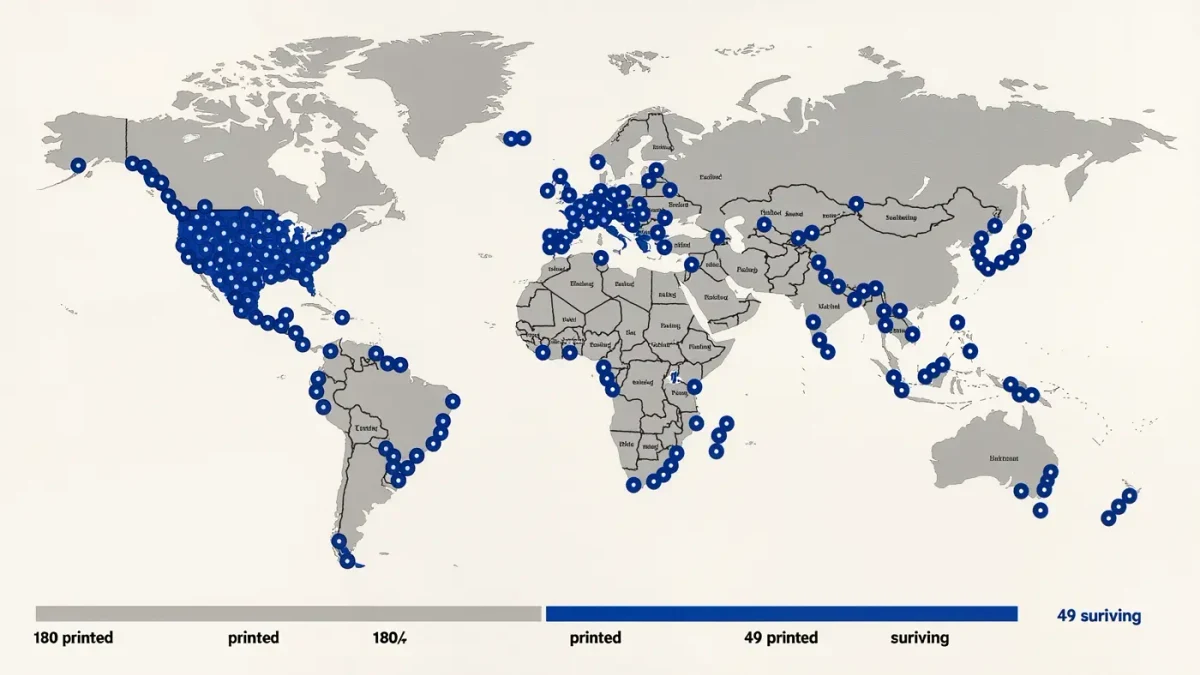
Of the roughly 180 copies of the Gutenberg Bible printed in Mainz around 1455, about 49 survive — modern counts land between 48 and 51, so scholars say “about 49” and move on. They sit in libraries from Washington to Tokyo, and the Library of Congress holds a complete vellum copy acquired in 1930 within a $1.5 million congressional purchase.
A survival rate approaching one in four would be remarkable for a paperback printed last decade. For a folio Bible that has been handled, rebound, taxed, bombed, flooded and catalogued for five hundred and seventy years, it approaches the inexplicable. The Gutenberg Bible’s afterlife is as much an institutional story as a typographic one: the survivors were bought early by institutions built to last, and they stayed put.
How many Gutenberg Bibles survive?
About 49, of which around twenty are complete — counts run from 48 to 51 because fragments and once-lost leaves keep surfacing and definitions of a copy vary. Most survivors are single volumes or fragmentary; a small group of complete copies on vellum sits at the top of the census, treated by their keepers less as books than as relics.
Since the nineteenth century, bibliographers have counted and recounted the survivors, and the number has been stable within a copy or two for a century. That stability is itself informative: the census implies an edition whose owners were recorded almost from birth, unusual for any incunable. The print run, by contrast, is an estimate — reconstructed from fifteenth-century documents rather than press records. The standard figure is about 180 copies, on one common breakdown roughly 135 on paper and some 45 on vellum.
A letter of March 1455 from Enea Silvio Piccolomini, the future Pope Pius II, records seeing quires of the new Bible and buyers already queuing, which is the principal evidence for dating completion to that year. Each copy runs to about 1,280 large folio pages set in two columns of 42 lines — hence the bibliographers’ nickname, the 42-line Bible — in a textura type of roughly 290 distinct sorts including ligatures, designed to pass as fine manuscript work.
Where do the surviving copies live?
Institutions hold nearly all of them, concentrated in Europe and the United States. The British Library keeps two complete copies; the Morgan Library in New York keeps three; the Library of Congress holds a complete vellum copy acquired in 1930 within a $1.5 million congressional purchase; Tokyo joined the map when Keio University bought a copy in 1987.
| Institution | City | Copy |
|---|---|---|
| Library of Congress | Washington | complete vellum copy, from the 1930 Vollbehr purchase |
| British Library | London | two complete copies, from the libraries of King George III and Thomas Grenville |
| Morgan Library & Museum | New York | three copies, the largest holding in one institution |
| Bibliothèque nationale de France | Paris | paper copy among the national collections |
| Gutenberg Museum | Mainz | vellum copy in the city of its production |
| Keio University Library | Tokyo | paper copy, acquired in 1987 |
The Washington copy arrived through Otto Vollbehr, a German chemist turned book millionaire who toured the volume among American colleges in the 1920s. In 1930, in a Depression-era budget fight, Congress appropriated $1.5 million for his collection of some three thousand incunabula, with the perfect vellum Bible as its centerpiece — among the better lines in public procurement history, and the anchor the Library of Congress uses for its display in the rare book division.
Why did so many copies survive?
Because the edition was born institutional. The buyers were monasteries, universities and wealthy dioceses that bought treasure-grade Bibles, stored them as treasure, and catalogued them as treasure; vellum, the survival medium, was its own climate control. Few copies were ever read to death — a folio Bible was for consulting, not consuming.
Completeness, in this census, is a stricter condition than survival. A copy counts as complete only if it retains its full sequence of quires across both volumes; copies missing a single gathering, or split between institutions, are counted separately and reunited only rarely. Paper copies survived at lower rates than vellum — damp, tearing and bookworm being democratic — so the vellum minority looms larger among the complete copies than it ever did on the press. The census, read closely, is a materials study disguised as a headcount.
Luck shared the credit with custody. Copies in German and Russian libraries lived through wars that destroyed the buildings around them; others were not so fortunate, and an unknown number of siblings vanished into private hands and damp cellars, which is why the census keeps wobbling between 48 and 51. The modern distribution itself is a product of the nineteenth century: secularization shook copies loose from monasteries, and industrial fortunes gathered them — the American collector Robert Hoe’s copy made $50,000 at auction in 1911, a then-record that reads like theft.
What is a Gutenberg Bible worth?
More than any institution will demonstrate. Complete copies have not reached the open market in decades; the benchmark remains 1930, when Congress paid $1.5 million for a collection whose centerpiece was a perfect vellum copy. Every appraisal since has been extrapolation — the objects are, literally, priceless: no seller, no price.
The recent decades of Gutenberg commerce have involved leaves and fragments: detached bifolia, quarried from damaged copies by twentieth-century dealers, sell for sums that would once have bought houses. A whole copy offered at auction would be a financial event without precedent in the printed-book market, which is exactly why no whole copy is offered. The Bible printed to be sold has become the book that cannot be bought — the terminal case of the market’s favorite paradox, value proven by refusal to trade.